Since the release of macOS Mojave, applications have required authorisation to access your personal data and locations including the ~/Documents and ~/Downloads directories.
Authorisation requests are routinely handled by macOS when an application requiring access is first launched. Occasionally, an application may need to be authorised by manually granting it access.
Before looking at how an application can be manually authorised, we need to configure Finder windows to display hard disks in the sidebar. Select Finder > Preferences > Sidebar and ensure that under Locations the Hard disk option is checked:
To manually authorise an application it needs to be given full disk access. Select System Preferences > Security & Privacy > Privacy > Full Disk Access and click the + button:
To give, say, the GitHub Desktop application full disk access, navigate to the /Applications directory, select GitHub Desktop.app and click Open:
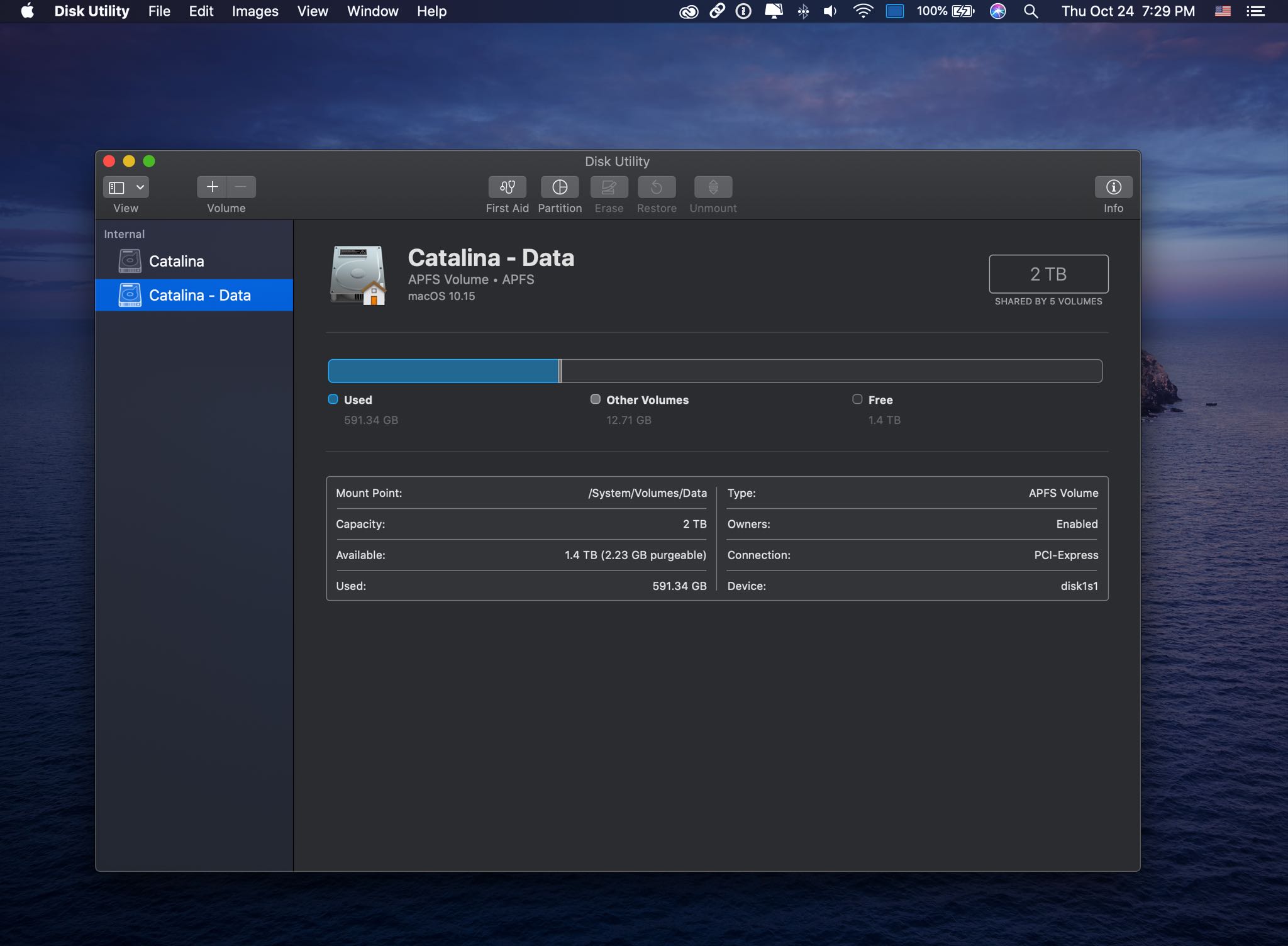
Select your hard drive in the Disk Utility window. It will be the first drive on the list. It might be named 'Fusion,' or 'Macintosh HD.' Click on the Partition tab. You will be prompted to either add an APFS volume or a Partition. Click Partition. Click the Add partition button it looks like a plus (+) symbol. In other words, Catalina protects the OS in its own read-only volume. The Catalina split. The Catalina installer renames the startup volume to “Macintosh HD – Data” (assuming your boot volume has the default title “Macintosh HD”) and assigns it the Data role. The installer also creates a brand new volume with the System role. With macOS Catalina, full disk access may need to be given to a program not located in the /Applications directory. An example is the bash interpreter that currently ships with macOS and whose binary is in the /bin directory. To grant /bin/bash full disk access, first click Macintosh HD in the sidebar of the Open dialog. Click Install macOS High Sierra — Quit Install macOS menu item at the virtual machine window top-left corner to quit mac os installation wizard. Then select Disk Utility in macOS Utilities window, click the Continue button. Select the virtual disk in Disk Utility left panel, then click Erase button at the top bar, it will popup a window.
With macOS Catalina, full disk access may need to be given to a program not located in the /Applications directory. An example is the bash interpreter that currently ships with macOS and whose binary is in the /bin directory.
To grant /bin/bash full disk access, first click Macintosh HD in the sidebar of the Open dialog:
The /bin directory – amongst others – isn’t shown until the + + . keys are pressed simultaneously:
Navigate to the /bin directory, select bash then click Open to grant the bash binary full disk access:
Macos Catalina Will Be Installed On The Disk Macintosh Hd Computer
This Open dialog method can also be used to grant full disk access to an application by selecting a symbolic link that points to that application. An example is /usr/local/bin/bash which is a symbolic link to the bash binary /usr/local/Cellar/bash/5.0.16/bin/bash installed through Homebrew:
An alternative to the Open dialog method is to first navigate to the application in the Finder, then drag and drop the application icon onto the Full Disk Access pane of System Preferences:
Macos Catalina Will Be Installed On The Disk Macintosh Hdmi
This drag and drop method doesn’t work with symbolic links in macOS Catalina. While it is possible to drag and drop the symbolic link icon onto the Full Disk Access pane of System Preferences, the application the symbolic link points to doesn’t appear to be granted full disk access. Consequently, only the Open dialog method described above should be used with symbolic links.
Creating a separate partition or volume on your Mac can be useful for different tasks as this allows you to designate a part of your hard-drive where you can install new software without allowing it to affect the rest of your system. In most cases, creating disk partitions and volumes is used by early adopters and beta testers of new macOS versions who want to install the beta version of the OS without removing the current stable version.
This is the recommended way of trying out beta macOS versions as it will keep them separate from the rest of your system and if there are any problems with them, this won’t affect the partition/volume where the current stable version of the OS is installed. This way of testing macOS beta versions also makes it easier to uninstall them afterward, once you decide you have tested enough.
Difference between a partition and a volume
Partitions and volumes are very similar and can be used for the same thing but there are some key differences that one must consider before deciding which of the two they are going to make.
What is a partition?
Creating a new disk partition on your Mac practically splits your hard-drive into two separate parts (partitions) that could have different macOS versions or even different OS types (for example macOS and Windows) installed on them. The amount of storage available on these partitions is predetermined by the user when they are partitioning the hard-drive and cannot be changed unless a new partitioning is performed.
Macos Catalina Will Be Installed On The Disk Macintosh Hd
Once you partition your hard disk, the overall storage space on your Mac will be separated between the new partitions according to how much storage you have assigned to each partition. If you are intending to create a separate partition for the purposes of installing a macOS beta version or the Windows OS on it, make sure that you assign to it enough free storage space. It is recommended that you assign at least 50 GB of storage to the new partition.
If your Mac has an HFS+ file system (Macs manufactured before macOS Catalina), it is advisable to create a new partition if you want to test macOS beta versions.

What is a volume?
Macos Catalina Will Be Installed On The Disk Macintosh Hd Vs
A volume is also a designated data container within your hard-drive, but it is stored within the same partition instead of being a new one. You can still install a different macOS version on it and this will not affect/replace the current stable macOS version that you are using. The advantage here is that you won’t have to worry about assigning enough HDD space to the volume like it is when you’re creating a new partition because the volume would expand the storage space that it uses from the current partition if need be, making it a more flexible option.
For example, if you install macOS Big Sur beta on one of your volumes, that volume would expand to accommodate the new macOS version, leading to a redistribution of the storage space within the partition. Of course, you still need to have the needed free storage space on your Mac as a whole to contain the new macOS version.

For Macs with APFS file system, Apple recommends creating a new volume within your current partition when attempting to install a separate macOS version in addition to your current one.
Always back up!
Every time you are about to make any significant changes in your system, it is best if you back up the data on your Mac to make sure that nothing gets lost in the process. Even though creating a new partition/volume is a safe process, mistakes can always happen, so it’s best to be prepared. There are different ways you could create a backup of your Mac and one of the easiest one is to use Time Machine. You can learn how to back up your Mac using Time Machine on this page (LINK).
How to create a partition on Mac
- Go to Finder from the Menu Bar at the top and select Applications on the right.
- Open the Utilities folder and start the Disk Utility app.
- Select your current hard-drive from the Disk Utility (it should be the first one from the list and would usually be named Macintosh HD or Fusion).
- Select the Partition tab and click on the Partition button.
- Select the Plus button to add a new partition.
- Use the slider to change the size of the partitions so that the one where you want to install another OS or macOS version has enough space for the installation.
- Give a name to the new partition and choose a system format type. If your current macOS version is 10.13 or higher, it is recommended that you go with APFS. If your current macOS version is 10.12 or older, it is recommended to pick Mac OS Extended.
- Select the Apple button and wait patiently for the process to complete without interrupting it.
Can Macos Catalina Be Installed On Macintosh Hd
How to create an APFS volume on Mac
- Go to Finder > Applications > Utilities and open the Disk Utility app.
- Select your current APFS drive from the sidebar (it should be named Macintosh HD by default if it hasn’t been changed).
- Type a name for the volume and pick an APFS format. It is recommended that you go with APFS.
- If you want, you can set size limits for the new volume so that it can’t go below or above certain size parameters. This can be useful if you want to make sure that the volume will never exceed a certain amount of storage space that it can use. To set size limits, click on Size Options.
- Next, enter a Reserve Size value – this will be the minimum storage space that will be available for this volume at all times.
- Enter a Quota Size value to set the maximum amount of disk space that can be used by this volume at any time. Make sure that this value is at least 40-50 GB to ensure that you can install the beta macOS version that you want to test (if this is the reason you are creating the volume).
- Finally, click on OK and then on Add to create the new volume with the parameters you’ve chosen.
How to switch between partitions/volumes
After you create a new partition/volume and install a different version of the macOS on it or an entirely different OS, you can switch between the different partitions/volumes on your Mac and use the different operating systems or macOS versions that are on your Mac.
- Go to the Apple menu (top-left side of the screen) and select the System preferences option.
- Open Startup Disk and then select the Padlock icon in the bottom-left part of the window.
- You will be asked to provide your admin password so do that and select OK.
- Select the OS you want to use after the restart and click on the Restart button.
After the restart, your Mac will boot with the OS/macOS version you have chosen from the Startup Disk window. If you want to test a macOS beta version, this is the one you must pick for the restart.
Installing macOS beta version
If you are interested in trying out a macOS version that is still in its beta state, you could do that so long as you have a developer Apple ID account. If you wish to learn more about how you can test beta macOS versions, visit this page and read the instructions provided there.