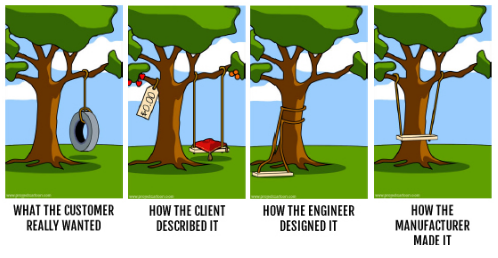
The simpler cartoons above are re-drawn from the old photocopied versions of the tree swing cartoon which., being directed toward software development. Apr 19, 2019 It depicts the difference of how each department interprets and implement a requirement in the development of a tree swing. The variation of the cartoon on perception gaps in software development projects first came out in 2003. Then it became popular among the management to address issues when projects did not go the right way. IT Projects and The Swing Cartoon Software projects are by definition people centric: software can only be produced by humans, and therefore all it requires is human capital and what goes with it (budget, communication.etc.). Since people are. As designed by the senior analyst. As produced by the programmers. As installed at the user's site. Free tree swing pictures (tire or tyre swing) - explanation of design or service by different departments, for quality and communications training.
- Cartoon Software Development Tree Swing Tutorial
- Cartoon Software Development Tree Swing
- Cartoon Software Development Tree Swing Tutorial
- Tire Swing Engineering Analogy
- Systems Engineering Tree Swing
- Project Management Swing Cartoon
- Tire Swing Cartoon
I was doomed to be an office worker because of my upbringing.
My father loves Dilbert. The family bookshelves are stuffed full with classics like Bring Me the Head of Willy the Mailboy, It’s Obvious You Won’t Survive By Your Wits Alone, and the management classic, The Dilbert Principle.
Over the past 26 years, Scott Adams has entertained millions of readers with his humorous workplace satire–and also poignantly highlighted some workplace problems that many easily glaze over.
One particular community that seems enamored of Dilbert is project managers. Many have been in offices where they have been micromanaged… or have become the pointy-haired boss themselves.
After scraping through thousands of Dilbert cartoons, I’ve found the best strips related to project management humor. Enjoy.
1.
Project managers with a PMP certification tend to outperform those who don’t have one. In order to pass the PMP exam, project managers must memorize project management vocabulary, understand project management processes, have experience in managing projects and, in some cases, must have taken project management courses.
With that said, PMPs can all too often get wrapped up in the minutiae of good processes–so much so that they hold them above the people they’re working with. No one wants to waste time in meetings, even if it’s vaguely recommended by other PMPs. Keep yourself grounded with real-time communication and simplified reporting that everyone can access and keep updated with instead of relying on meetings to do so.
2.
“Resource allocation” is a term familiar to many project managers, and it can often refer to people in addition to non-human assets.
Cartoon Software Development Tree Swing Tutorial
Project management can often be a cold industry, where numbers and deadlines outweigh your team members’ desires and even capabilities. Keep in mind that your team members are people and that they each have their own unique needs and values.
3.
For many companies, risk management software adds safety to your project.
Unfortunately, even the best systems can’t function without the cognitive skills of a human working on the project (unfortunately, the successful Turing test has yet to come to risk software). If the data that you input does not match reality, your software will become useless.
4.
The Project Management Institute has continually found that poor communication is at the heart of most project failures.
There are many reasons for this, but the most common mistake that leads to poor communication is a poor system. Emailing every thought is unsustainable, but zero communication ultimately leads to project failure.
Investing in project management software is one of the best ways of addressing communication issues. In fact, 52% of project managers say that communication was “significantly improved” after implementing PM software. Consider using PM software instead of email–for instance, tools like Asana, Wrike, and Trello can help optimize communication.
5.
We have all met this project manager (or boss).
Cartoon Software Development Tree Swing
The know-it-all attitude is not only grating but also unhelpful. No team member wants to work for a “holier than thou” manager in any setting.
In this strip, Ratbert does not consider the skills of those he’s working with–he wants to dole out menial tasks while he does all the real thinking. Project managers cannot expect to come up with the best solutions to all problems all the time, and they can’t expect to have all their team’s individualized, specialized skills.
Make use of your team–distrusting your team to do any of the critical thinking will only end in disaster.
6.
Along the same lines as the previous cartoon, here Dilbert doesn’t trust his team not to sabotage his project. Unfortunately, that means he is not sharing the purpose or the scope of the project.
Cartoon Software Development Tree Swing Tutorial
Can you spell d-i-s-a-s-t-e-r?
There is little that can be gained from keeping your team members in the dark. Transparency is the key to trust–and a team that trusts its leader will outperform those that don’t. Every time.
7.
As far as communication goes, I often hear project managers complain about their team members refusing to put in updates to their software, or having to chase down individuals for simple status updates.
On the other end of the spectrum, it’s also up to project managers to keep themselves informed. If checking status reports and staying up to date isn’t a part of your daily routine, you are opening up your project to unnecessary risk. Forecasts and requirements easily change. Don’t fall victim to your own inability to receive information.
8.
We’ve all heard stories about difficult team members. Some project managers get frustrated and chalk up inefficiencies with an unalterable personality trait. For example, the project manager here might think Wally is lazy, unavailable, and insubordinate.
In this case, that might very well be the reality. In the real world, however, there are many more variables. For example, the team member might think you’re unapproachable, unrealistic, and cold.
Invest in cultivating your workplace personality to best fit with project management, and try to get real-time feedback from your team members about your management style. Don’t wait for them to come to you.
9.
We’ve all experienced this problem. Unfortunately, dependencies are the greatest downfall to the Waterfall method of project management.
Going Agile, particularly for software products, is one way of addressing this issue, as is having realistic deadlines and properly matched tasks with skills.
Well, that and hiring competent employees, as is the issue in this strip.
10.
Ah narcissism.
Listen when your team is trying to communicate with you. If you’ve built a reputation for poorly receiving information and status updates, you’ve set yourself up for poor team management.
No one wants to be the pointy-haired boss.
No one.
More?
There are literally thousands of Dilbert cartoons ripe for project management commentary. I’m sure I missed a ton. What is your favorite Dilbert strip? Anything to add to the ones I’ve included above?
Leave your favorites in the comments below!
Looking for Project Management software? Check out Capterra's list of the best Project Management software solutions.
One of the biggest challenges of software development is aligning technical details with an organization’s business requirements. This is an essential concern if you want to put ideas, applications, and processes into the real world successfully — whether they are virtual in software or physical in hardware. Until we’re able to bend the laws of physics, conjure infinite computational power, or rewrite applications on the fly to do our bidding, technology will pose certain limitations that prevent lightning-fast innovation. Navigating these limits using real business requirements as a guide post is the key to successful outcomes.
If you’ve been involved in any kind of software project management, then you’re more than likely familiar with the infamous tire swing cartoon — which is actually an older analogy relating to general project management, but has since been adapted to all kinds of disciplines from customer service to manufacturing to software. For reference, here is the software version I’m talking about:

We’ve all had those moments with customers, analysts, and co-workers. You unveil a product feature you’ve been working on for months, and a look of horror starts to spread across their faces. Something has gone drastically wrong. You failed to ensure that your product feature — which is beautiful, by the way — addresses business objectives. This is like a tire swing without a tire attached, or perhaps strung to the tree in an unswingable way. You’re headed for missed deadlines, duplicated efforts, dead-on-arrival deliveries, and unhappy customers who will be deprived of the joys of swinging on a tire. Let’s look at some ideas for how we can avoid this unfortunate disconnect.
Ask yourself: Is it feasible and functional?
The first thing to do is define each business requirement on paper, and make sure that everyone involved in meeting this goal can answer the question “Is it feasible?” Sometimes decision makers want a tire that can swing through the tree, or swing in a direction perpendicular to the direction of gravity, and that’s a clear sign that they need to be re-evaluate their objectives for feasibility. Altering the laws of physics is a tall order for (most) engineers, so requests for impossible situations must be identified and addressed.
In the software world, an impossible requirement may involve pushing the boundaries of computing power or storage. Let’s say that an organization relies heavily on image processing as its core business. If a business requirement is to have an application crunch through an absurdly large number of images in an absurdly large resolution in an absurdly tiny fraction of time, this will simply not be feasible — not yet, anyway.
Tire Swing Engineering Analogy
The second question organizations need to ask is “Is it functional?” Put together a functional requirements document that translates the business requirements into functional requirements. However, this is just a start — remember that even impeccably and explicitly well-written functional requirements can still ruin the spirit of the customer’s request (or need).
For instance, a tire attached to the trunk of a tree could technically still be a swing if you were to uproot the tree and mount it sideways, right? Or attaching the tire to two limbs on either side of the trunk so that it can only swing through the trunk is still a swing — just not a functional swing.
Systems Engineering Tree Swing
Break it down and make a plan
Now break down the business requirements into a real plan that your engineers can execute on. The process will vary across different products and technologies, but break the requirements down into their component parts and create a timeline of deliverables to plan and schedule the work.
Start by asking some fundamental questions. If we want a tire to swing, it will need to swing from something — what will that be? Will that structure need to be built from scratch, or can we use something that already exists — a tree perhaps? How will we attach the tire to the tree? Should the swinging be initiated manually, or completely automated? Embracing agile is one of the best ways to get the Minimum Viable Product (MVP) in front of the customer as soon as possible, and get feedback in flight. If you take great care to break the requirements down, Waterfall is also a good option, though be aware it can involve a lot of back-and-forth conversation, diagrams, and meetings.
Project Management Swing Cartoon
Then, it’s finally off to the races! Create a plan and schedule the work to be done, with a detailed timeline estimating how long each step will take. Be sure to account for the realistic constraints that will affect you — e.g., can you build your tire swing in the middle of winter in Milwaukee? Sometimes the priorities or plans of others will also have an impact, like if your security group is working on a project or your infrastructure team has major changes coming.
Tire Swing Cartoon
Herding the cats of business requirements, technical details, and functional requirements is no easy feat, but proper consideration of feasibility and functionality can help as a first pass. Getting a good understanding of the requirements, breaking things down into manageable parts, and have a game plan can help ensure success.